

My daughter is teaching me how to speak, and by extension, how to see and to feel (abilities I have all but lost).

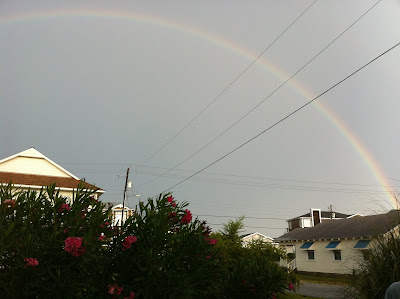
"Bew-fuls, bew-fuls," she says, while looking at the shells we collected at the beach in NC last week. Does she really say beautiful, now? I can't even believe this. "Water comin," she says, when the ocean is roaring toward us, and there is no way to convey how absolutely perfect that word "comin" sounds when she says it. It is the sweetest thing. "Rainbow fall down" she says while reading and re-reading the Noah story, with which she has become sincerely fascinated. For that matter, "Animals comin" and "Fire comin" also feature prominently in the Noah readings.
Which brings me to the "deep fire," or dehumidifier, which was required when I flooded the bathroom at the beach house (oh no, no, no, but all too true). "Petties, petties (pretties)," she says of the small stones we collected on Martha's Vineyard earlier this summer.

"Rainin, poh-in" she sings, then, "ah, moh-nin, ah, moh-nin." Sean and I can't figure out if this is some song abut Morning that we don't know where she learned, or if she's simply singing in her own language, as sometimes when we say "I love you," and she responds, "Ah Mohnin," and then starts singing this poetic phrase over and over. It's what she sings when feeling happy or comforted, and more than anything, it comforts us. It tells us that it's all going to be alright--really Mommy, really Daddy, really it is.
Two of my Superimposed Cities paintings have been published in Issue 16 of RUMINATE, a gem of a magazine "created in 2006 by a few fellow writers, artists, and believers who wanted a space for the thoughtful expressions of those who are nudged forward, backward, and sideways by faith in God." The images are not in the online issue, but here at least is the Table of Contents with links to a few sections of the issue posted online. I am posting the two paintings here and you can also see them on my site:


Both of the paintings, like the rest of this series (started in '06 and as yet unfinished) feature overlapping city maps. ‘Sow: Jerusalem/New York’ (2006, blue) marks the death and resurrection of Christ and the city where I live; ‘He turned their waters into blood’ (title from Psalm 105:29, 2007, red) marks the cities devastated by Hurricane Katrina and the U.S. War in Iraq. Sheer pockets containing seeds hover in the footprints of historically significant landmarks, from Calvary to the Iraqi National Museum to the New Orleans Superdome. (See key to Waters into Blood here for more details).
I am honored and so happy that these pieces are being published the same month that I sold another piece from the series, Hearing the land that was now of my blood and flesh (title from Faulkner's As I Lay Dying). This piece will eventually go to live with its new owner in Japan--I'm thrilled that what started as a document of and about the place where I make my home, will make its own home in a far away place that intrigues and mystifies me, a place I hope to visit again soon.
 Perhaps this convergence means that I need to sit down and take stock of this work, lest I forget to make more of it, forget to continue where I left off (when I had my little creature and became obsessed with making Little Creatures live and breathe). So, while the spotlight is on these pieces that I often think of as my "real work," (as opposed to the many small paintings and mixed media pieces, not to mention the jewelry and mobiles and toys and oh, did I say . . . films? Oh yeah, the other "real work," fill the space around me), it might be worth noting here how many times I have written and rewritten my artist's statement concerning these Superimposed Cities. The pithy statement that ends up in my Ruminate bio, "Using a range of materials to collapse space and time provides a transformative way for me to process meaningful and traumatic events," has come a long way over these past four years. So as if to prove that "artist's statement" were the most ridiculous oxymoron, here are some previous incarnations, from dozens of grant and show applications . . . tracing the idea from its genesis, back in 2000, when I was simply cutting into canvas and suspending seeds within sheer fabric attached to the edges of holes, to 2006, when I started drawing cities one on top of the other, suspending the seeds and other natural materials within footprints of buildings:
• My cuts and stitches into my canvases, my stuffing of bits and pieces of the earth, further connect abstract to real.
• I am intrigued that a painting might rupture and give way to sculptural forms, almost of its own will. Perhaps this is a way that I can reconcile my need to make both two and three-dimensional work. Perhaps this is a rebellion of the will, because I know that painting can always reach for the illusion of beauty or reality or life, but can never truly become something that I can hold in my hands and love. Just as I chase light with strokes of a paintbrush, I chase form so far that I must bring the surface and build out from within.
• I cut into the canvas and stuff sheer pockets of fabric with bits and pieces of the earth and its elements--seeds, twigs, moss, stones and glass, to disrupt the picture plane and create a more dynamic interplay of image and object, and to include the actual reference points of my paintings, in the paintings themselves.
• By combining disparate elements, I am seeking to make sense of life, death, the injustice of war and the possibility of grace.• The streets of Ancient Rome intersect those of present-day Washington, D.C. ('Seeds of Empire'); the streets of my neighborhood of Red Hook, Brooklyn, intersect those of William Faulkner's Yoknapatawpha County, Mississippi, of the 1920's ('Hearing the Land'), collapsing time and space and welcoming stories into dialogue with one another through visual relationships.
• 'Seeds of Empire' asks the viewer, what is empire, where did it begin, where is it going, and will it implode within our lifetime? Buildings represented by roots and seeds shown in their fullness: the Imperial Fora, Colosseum, Basilica Julia and the Capitolium. Buildings represented by seeds shown in late and rotting stages: White House, Capitol, Senate and Congressional Buildings, and the Supreme Court.
• I cut into canvases to stuff and sew sheer pockets of fabric with bits and pieces of organic objects, marking significant points on these maps where the course of history has changed.
• I am incorporating drawings of superimposed city maps to create imaginary cities from disparate yet sociologically relevant urban areas, as seen from above.
• I superimpose city maps on top of one another, such that new, imaginary cities spawn from disparate, yet sociologically relevant, and very real, times and places.
• I superimpose cities, fabricating locales out of disparate times and places. I stuff sheer pockets of fabric with organic objects and sew them into the canvas to mark significant historical points on the maps.
• These pieces serve as the personal account of the horror I have experienced as these cities have crumbled in more ways than one.• These pieces serve as a personal account of the horror I have felt as these cities have crumbled in more ways than one, and a meditation on the ephemerality of civilizations.
• I create a new reality as a collapsed space-time continuum, where far-flung places and events are inextricably entwined.• Through these painted and sewn documents, I challenge viewers to see reality as a collapsed space-time continuum, wherein related current and past events are inextricably entwined.• Through these painted and sewn documents, I challenge viewers to see reality as a collapsed space-time continuum, and to see the beauty and horror of current and past, true and fabricated events for what they are--inextricably entwined.


